
What is Ausbildung and who can apply?
Paid vocational training in Germany explained: the two types, trainee pay, who can apply after 12th, German level, visa money and steps from India.
Xpolariz counselling team
Published , 8 min read
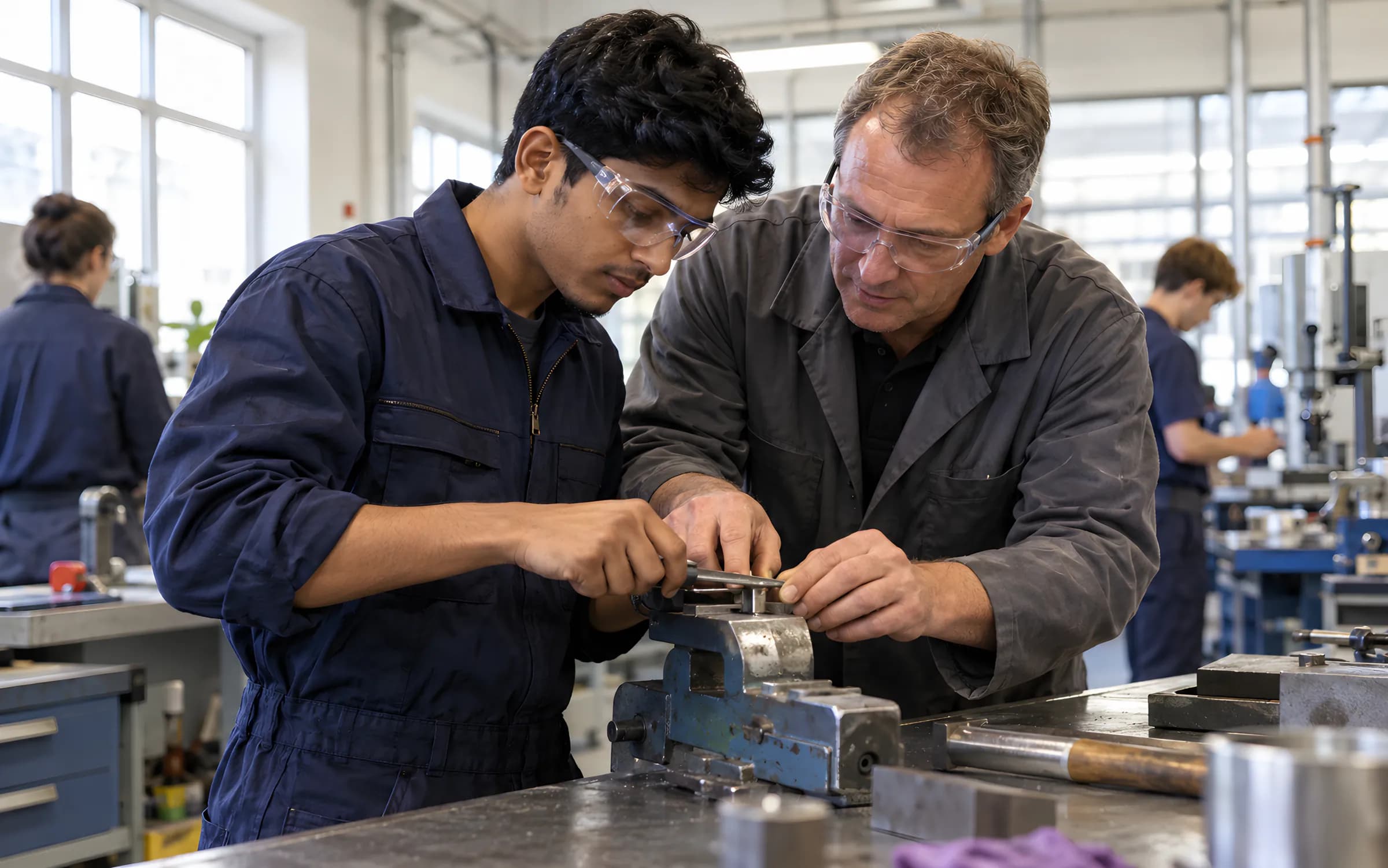
Ausbildung is vocational training in Germany. You learn a skilled job, such as nursing, cooking or electrical work, and finish with a German qualification. In company-based training, a company trains you and pays you every month. For a student in India who likes practical work, it is a real option to compare with a university degree.
Pay and visa figures here are for 2026 unless the text says otherwise. They come from official German rules and public pay agreements.
What Ausbildung is
Ausbildung trains you for one named job. You learn the theory at a vocational school and the practical work at a real workplace. At the end you take a final exam. When you pass, you hold a German vocational qualification for that job.
Company-based training usually takes two to three years, according to Make it in Germany, the German government's portal for skilled workers. School-based training usually takes one to three years. Some trades take longer. Industrial mechanic, for example, takes three and a half years, which is 42 months. Most company-based training starts on 1 August or 1 September each year, so plan your German and your applications around that start date.
Company-based (dual) or school-based training
There are two types of Ausbildung, and they work very differently. Read the programme details carefully before you compare offers, because the money rules are not the same.
- Company-based (dual) training: you work at a company and spend one or two days a week at a vocational school. The company pays you a training salary every month.
- School-based training: you study full time at a vocational school and do internships at the same time. It is used mainly for jobs in social work, healthcare and nursing, and education. It usually takes one to three years.
In school-based training you do not get a fixed salary. Public vocational schools are free, but private schools often charge tuition fees. Healthcare is the exception. Trainees in healthcare spend long practical phases in hospitals or nursing homes and are paid throughout the training.
Professions with good demand
Make it in Germany names training fields where Germany needs people. They include nursing, transport and logistics, electronics and metal work, construction and finishing trades, and hotels and restaurants. These are good places to start your search.
Choose the job first, then the city. Look at what you would do every day for three years. A student who enjoys caring for people may suit nursing. A student who likes tools and machines may suit electronics or mechanics. A student who likes cooking may suit hotel and restaurant training. Liking the work matters, because you will spend most of your week doing it.
How much trainees earn
In company-based training, German law sets a minimum training salary. For training that starts in 2026, the minimum is EUR 724 a month in year 1, EUR 854 in year 2, EUR 977 in year 3 and EUR 1,014 in year 4. For training that starts in 2027, it rises to EUR 764, 902, 1,031 and 1,070. All these figures are gross, which means before tax and deductions.
Many trainees earn more than the minimum, because their company follows a collective agreement. The Federal Institute for Vocational Education and Training (BIBB) reports that the average agreed training salary in 2025 was EUR 1,209 a month. Here are some agreed salaries from 2025, for years 1, 2 and 3:
- IT specialist (Fachinformatiker): EUR 1,211, 1,279 and 1,356.
- Cook: EUR 1,120, 1,233 and 1,346.
- Hotel specialist: EUR 1,112, 1,231 and 1,347.
- Professional driver: EUR 1,114, 1,200 and 1,290.
- Warehouse logistics: EUR 1,171, 1,247 and 1,330.
- Electronics technician in the crafts (42 months): EUR 979, 1,050 and 1,125, then EUR 1,201 for the last half year.
Nursing trainees at municipal and federal public employers (TVAöD-Pflege) earn EUR 1,490.69 in year 1, EUR 1,552.07 in year 2 and EUR 1,653.38 in year 3, from 1 May 2026. Private and church employers can pay differently, so check the figure in your own contract. One more rule: a company bound by a collective agreement may pay that agreement's rate, even if it is below the legal minimum.
Who can apply after 12th in India
The rules depend on the type of training. For company-based training, German law does not ask for a specific school certificate. Each company decides what it wants from applicants. In practice, many companies ask for an intermediate school certificate. For school-based training, you must have finished your general schooling and have that certificate officially recognised. The exact certificate depends on the profession.
There is no age limit for starting vocational training. You may read online that you must be under 35. That rule belongs to a different visa, the one for coming to Germany to look for a training place. That visa is for people under 35, with a school certificate that gives access to higher education and secured living costs, and it is issued for up to nine months. If you already have a signed training contract, you apply for the training visa instead.
How much German you need
Make it in Germany says you will normally need German at level B1 for the training visa. The German missions in India say at least A2 for training, and at least B1 for medical professions. Your company or school can ask for more than this. Nursing training also needs B1 or B2, depending on the German state.
Do not plan for the lowest level that gets you a visa. Ask your school which language its lessons and exams use. If it is German, plan for more than the visa minimum. A trainee with stronger German follows the lessons, talks to colleagues and passes the exams with less stress. Aim for the level your training needs, not only the level the visa accepts.
The training visa and money proof
For the training visa, you must show that you can pay for your living costs in Germany. The rules for 2026 depend on the type of training.
- Company-based training: your training salary counts as proof. If it is at least EUR 1,048 gross or EUR 822 net a month, your living costs are covered. If it is lower, you add a blocked bank account or a declaration of commitment to cover the gap.
- School-based training: you show the money with a blocked bank account, a declaration of commitment or a scholarship. You need at least EUR 959 net a month.
A blocked account is a German bank account that releases a fixed amount to you each month. A declaration of commitment is a formal promise by someone in Germany to pay your living costs. With a training permit, you may also take a second job of up to 20 hours a week, if it has nothing to do with your training.
Steps from India
- Choose a profession and decide between company-based and school-based training.
- Learn German to the level your training and visa need, and take a recognised exam.
- Apply to companies or schools, attend interviews and read the contract before you sign.
- Check your training salary against the money rule above, and plan how to cover any gap.
- Apply for the training visa through the Consular Services Portal of the German missions in India.
The missions' checklist for the training visa includes a valid passport, proof of German, the training contract signed by you and the company or school, a motivation letter, your 10th and 12th mark sheets and health insurance. For company-based training you also need confirmation that the contract was registered with the right institution, such as the Chamber of Commerce. Your training company usually arranges this registration.
After Ausbildung
When you pass your final exam, you are a qualified skilled worker in Germany. You then have up to 18 months to find a qualified job. With a job, you can get a residence permit as a skilled worker with vocational training, which lets you work in any qualified job.
So plan for the years after training too. In company-based training you are paid while you learn, and the qualification leads to skilled work in Germany afterwards.
Request a free call back to talk about your 12th marks, your German level and the job you want to train for. A counsellor explains every cost before you pay anything.